
Palantir Is Not an AI Company — It's a $300 Billion Consulting Firm Wearing a Software Costume
Short sellers have been screaming it for two years. Citron Research, Michael Burry, and a growing chorus of Wall Street analysts agree: the gap between Palantir's narrative and its actual business model is one of the most dangerous fictions in today's market.
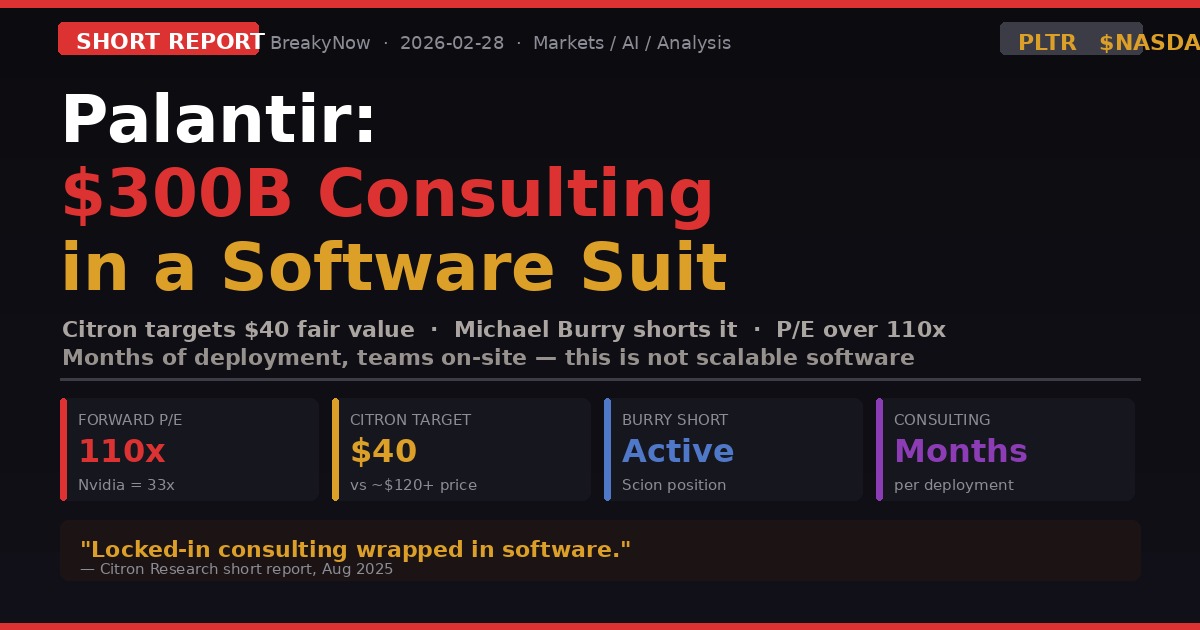
There is a particular kind of financial alchemy that only works during a bull market: take a real but modest business, wrap it in the language of the era's dominant technology trend, hire a CEO who gives scorching speeches and antagonizes short sellers on live television, and watch retail investors bid the stock into the stratosphere. Palantir Technologies has been the purest expression of this formula in the AI era — a company with genuinely real technology and genuinely real government contracts, packaged and sold to the public as though it were the next Google. It is not. And the short sellers who have been saying so, loudly and publicly, are increasingly being proven right not by fraud but by something more mundane and perhaps more dangerous: the slow, grinding collision between a cult narrative and the cold arithmetic of what the business actually is.
🐻 The Short Seller Dossier: Who Has Said What
The bear case on Palantir is not the work of fringe operators. It has been assembled, piece by piece, by some of the most prominent names in institutional skepticism — and the thesis has remained remarkably consistent across all of them: the company's stock price is detached from any reasonable valuation framework, the business model is less scalable than advertised, and the AI narrative is obscuring the slow, labor-intensive reality of how Palantir actually delivers value to its customers.
Citron Research (Andrew Left): In August 2025, Citron published what became the most discussed short report of the year, targeting Palantir directly after the stock had already doubled in 2025 to become the S&P 500's best-performing name. Left's core argument was mathematical rather than conspiratorial: OpenAI, widely recognized as the actual leader in generative AI, was at that moment raising capital at a $500 billion valuation with projected 2026 revenues of $29.6 billion — a price-to-sales ratio of approximately 17x. Palantir, a company projected to generate $5.6 billion in 2026 revenue, was trading at a multiple that implied a market cap of roughly $400 billion. Applying OpenAI's own (already extreme) multiple to Palantir's revenue would yield a fair value of $40 per share — roughly one-quarter of where the stock was trading at the time. Left was explicit about the implication: "If this was the greatest company that was ever created and we gave it the same multiples as Nvidia in 2023, the stock still gets cut by two-thirds. No company with a multiple or PE like this has ever avoided a 50% correction." Palantir's stock fell more than 9% in a single session on the report's publication and has since declined roughly 30% from its all-time highs.
Michael Burry (Scion Asset Management): The investor who famously bet against the entire U.S. housing market in 2007 — depicted in the film "The Big Short" — revealed a short position in Palantir alongside Nvidia in late 2025. Burry's involvement is notable not for its size but for its signal: he is not a momentum trader chasing a quick move. He takes concentrated positions based on fundamental overvaluation. His bet against Palantir carries the same structural logic as his housing short: the asset is priced for a future that cannot mathematically arrive on the timeline the market is assuming. CEO Alex Karp's response — calling short sellers "super triggering" and accusing Burry of "market manipulation" in two separate CNBC appearances in a single week — did little to help the stock, which fell 8% immediately after earnings despite a top-and-bottom-line beat.
Wall Street analyst consensus: Beyond the dedicated short sellers, the institutional analyst community has been broadly skeptical. At Palantir's peak, only 2 of 8 surveyed analysts rated the stock a Buy. Jefferies praised the business but said the risk-reward favored Microsoft and Snowflake. Mizuho called the risk-reward a "big challenge." D.A. Davidson's Gil Luria reiterated a neutral rating and said the company was "raising the bar even higher" for expectations. Goldman Sachs noted that the more muted post-earnings reaction came in "the context of high expectations" — in other words, the market had already priced in perfection, and perfection was no longer enough. At current levels, even after a 30% decline from the high, Palantir's forward P/E sits at approximately 110x — a figure that requires the company to sustain its current extraordinary growth rate for years without interruption. Nvidia, one of the most dominant companies in tech history, trades at 33x. Meta trades at 22x. Tesla, historically one of the most expensive growth stocks in the S&P 500, trades below Palantir on a forward earnings basis.
🔍 The Business Model Problem: Consulting in a Software Costume
Strip away the stock price and the CEO's rhetoric, and what does Palantir actually do? The honest answer — the one that Wall Street's most careful analysts have been circling for years — is that Palantir is primarily a data integration and workflow consulting firm that has built a proprietary software layer on top of that consulting work. This is not a criticism of the technology's quality. It is a structural observation about scalability, and scalability is precisely what a stock at 110x forward earnings is being priced for.
Palantir's model works like this: the company deploys its own engineers — called Forward Deployed Engineers, or FDEs — directly into a customer's organization. These are not salespeople. They are builders who sit alongside the client's teams, understand the client's specific data architecture, regulatory environment, and operational workflows, and then customize Palantir's Foundry or AIP platform to fit those unique needs. This process takes months. The initial "bootcamp" — Palantir's heavily marketed 5-day rapid prototyping sprint — produces what the company calls a minimum viable product, but that MVP is not a deployed production system. It is a proof of concept that then requires weeks or months of additional FDE time to build into something that actually runs the client's operations. Citron Research put it plainly in its 2025 short report: "Palantir is essentially locked-in consulting wrapped in software." Andreessen Horowitz, in a widely read analysis titled "The Palantirization of Everything," was even more specific: "Palantir's customers implicitly sign up to co-evolve the product with them; they tolerate a lot because the stakes are high and alternatives are limited. Most enterprises, particularly outside of defense and regulated sectors, do not want to feel like a long-running consulting project."
This is the structural ceiling that the Palantir bull narrative conveniently ignores. Every major deployment requires Palantir's own engineers, on-site, for extended periods. The company is not selling a SaaS product that a customer can spin up in an afternoon and pay for monthly. It is selling a co-development engagement that requires Palantir to staff a team inside your organization, understand your data, build the integrations, and iterate through multiple cycles before the system goes live. That process is valuable. For defense agencies and intelligence services, where the problems are existential and alternatives are literally nonexistent, it is worth every dollar of the engagement fee. But it is not scalable in the way that a true software platform scales — and it is certainly not scalable in the way that a $300 billion market capitalization demands.
📉 The AIP Bootcamp: Marketing Genius Disguising a Fundamental Constraint
Palantir's AIP Bootcamp — the "zero to use case in 5 days" program that became the company's primary commercial sales motion in 2024 and 2025 — is one of the more sophisticated pieces of narrative engineering in recent corporate history. On the surface, it represents exactly what Wall Street wants to see from an AI software company: rapid deployment, immediate time-to-value, a scalable go-to-market engine that doesn't require a large traditional salesforce. Palantir's CEO Alex Karp famously said he wouldn't hire salespeople unless he were "hit by a bus" — the bootcamp was supposed to prove him right.
But look more carefully at what the bootcamp actually delivers. The five days produce a prototype — built by Palantir's own engineers, using the client's own data — that demonstrates what AIP could do for that specific organization's specific use case. The client leaves with a demo. They do not leave with a running production system. The Everest Group research report on Palantir's model describes the actual arc plainly: "A first engagement might cover a short bootcamp and limited licenses. If value is proven, additional use cases, workflows, and data domains are layered in. Over time, the revenue mix tilts toward software subscription rather than services." The phrase to hold onto is "over time." The bootcamp is the first step in a months-long engagement that only gradually converts from a services-heavy, custom-deployment model to something resembling the recurring software subscription revenue that investors are paying a software multiple to own. The company itself acknowledges that FDE time is required — Palantir funds that engineering time upfront, as an investment in winning the customer. But that means every new commercial customer is, at least initially, a cost center. Scale that model to the thousands of customers that a $300 billion market cap requires, and the math does not work unless the FDE-to-subscription conversion happens faster and at higher margins than the company's own history suggests it does.
The comparison to Snowflake is instructive. Snowflake, which operates in genuinely comparable data platform territory, was growing revenue at over 100% year-over-year at its peak. Today it grows at 29% year-over-year — still impressive, but a fraction of its former rate — and its entire market capitalization is roughly $78 billion, less than one-fifth of Palantir's. The bear case is not that Palantir's growth will collapse. It is that growth will normalize, as it always does for data platforms, and when it does, there is no version of the math that supports a $300 billion valuation.
🏛️ The Government Dependency That Never Goes Away
The bull narrative on Palantir in 2025 and 2026 has centered heavily on the explosive growth of its commercial business — U.S. commercial revenue grew 121% year-over-year in Q3 2025, and 137% in Q4 2025. These are genuinely extraordinary numbers. But they exist within a company where U.S. government revenue still accounted for over 40% of total revenue in Q4 2025, where the top three customers represent 16% of all revenue, and where the single most important contract in the company's portfolio — the $10 billion U.S. Army Enterprise Agreement — is a decade-long deal that consolidates 75 prior contracts and creates massive revenue concentration in a single government relationship.
Government contracts, however large, are not software products. They are procurement relationships. They are subject to congressional budget cycles, administration priorities, policy changes, and procurement freezes. The DOGE-driven federal spending review that characterized early 2026 raised real questions about Palantir's government exposure — including whether some of the company's contracts might be scrutinized or restructured as part of broader federal efficiency initiatives. This is not a theoretical risk. It is the defining structural vulnerability of a company that is priced like a consumer internet platform but still depends on bureaucratic procurement timelines for nearly half its revenue. Motley Fool analysts put the underlying tension plainly: "Government exposure and sky-high expectations leave little room for disappointment." When you trade at 110x forward earnings, a single quarter of government revenue softness — or a single contract delay — can shave 20% from a stock price in days.
📊 The Valuation Math That Doesn't Work
Let's be concrete. As of late February 2026, Palantir's stock has fallen approximately 30% from its all-time high but still commands a market capitalization north of $300 billion. The company generated approximately $4.5 billion in trailing twelve-month revenue and $1.6 billion in net income. The forward P/E at current prices sits around 110x. For context, a "reasonable" long-term valuation for a high-quality software business — the kind that compounds value for a decade — is typically in the 40–60x earnings range. To grow into a 50x P/E at today's market cap, Palantir would need to generate approximately $6.82 billion in net income. At its current 43% profit margin, that requires approximately $15.8 billion in annual revenue. At its projected 2026 revenue of $7.2 billion and a 60% growth rate, that level of revenue would take roughly three years to reach — assuming that growth rate is perfectly maintained, which no software company in history has done at this scale. Motley Fool's Keithen Drury captured the structural problem: "The stock is simply priced for perfection, leaving essentially no room for error — and not even enough room for a natural deceleration in the company's growth over the next five years."
The free cash flow yield — perhaps the most honest valuation metric for a software company — is below 0.5% using Palantir's own full-year guidance. An investor buying Palantir today is paying more than 200 times the cash flow the business generates annually. The company's market share in the broader AI software sector remains below 0.3%. And the total contract value growth — the metric that best predicts future revenue — decelerated from 151% year-over-year in Q3 2025 to 138% in Q4 2025. A 138% growth rate is extraordinary in isolation. But in the context of a $300 billion market cap that demands sustained extraordinary performance for years, it represents the first visible crack in the acceleration narrative.
The Uncomfortable Truth Wall Street Doesn't Want to Say Out Loud
None of this is an argument that Palantir is a bad company. It is a genuinely innovative data integration and AI platform provider with real technology, real customers, real government relationships, and real revenue growth. The argument is simpler and more uncomfortable than fraud: Palantir is an extraordinarily expensive stock for what is, at its core, an extraordinarily labor-intensive, deployment-heavy, consulting-adjacent business that happens to have built a good software platform to anchor those deployments. The companies that trade at the multiples Palantir commands are businesses where the marginal cost of serving the next customer approaches zero — cloud platforms, consumer apps, advertising networks. Palantir's marginal cost of serving a new customer involves flying a team of engineers to the client's headquarters for months. Those are not the economics of a company worth $300 billion. They are the economics of a high-end technology consulting firm, priced like it invented electricity.
The short sellers are not betting on fraud. They are betting on gravity. And history, without exception, suggests that gravity eventually wins.
This article presents analysis and publicly available short seller research for informational purposes only. It does not constitute financial advice. Palantir Technologies has strong defenders on Wall Street and a track record of exceeding expectations. Investors should conduct their own due diligence before making any investment decisions.