
Crypto's Unprecedented Collapse Is Already Underway — And Most Investors Haven't Noticed Yet
Spot volumes at FTX-era lows. Retail capital wiped out by Pump & Dump cycles. Futures traders liquidated out of existence. And DAT companies sitting on a domino that, once tipped, could send Bitcoin below $50,000 for the first time since 2023.
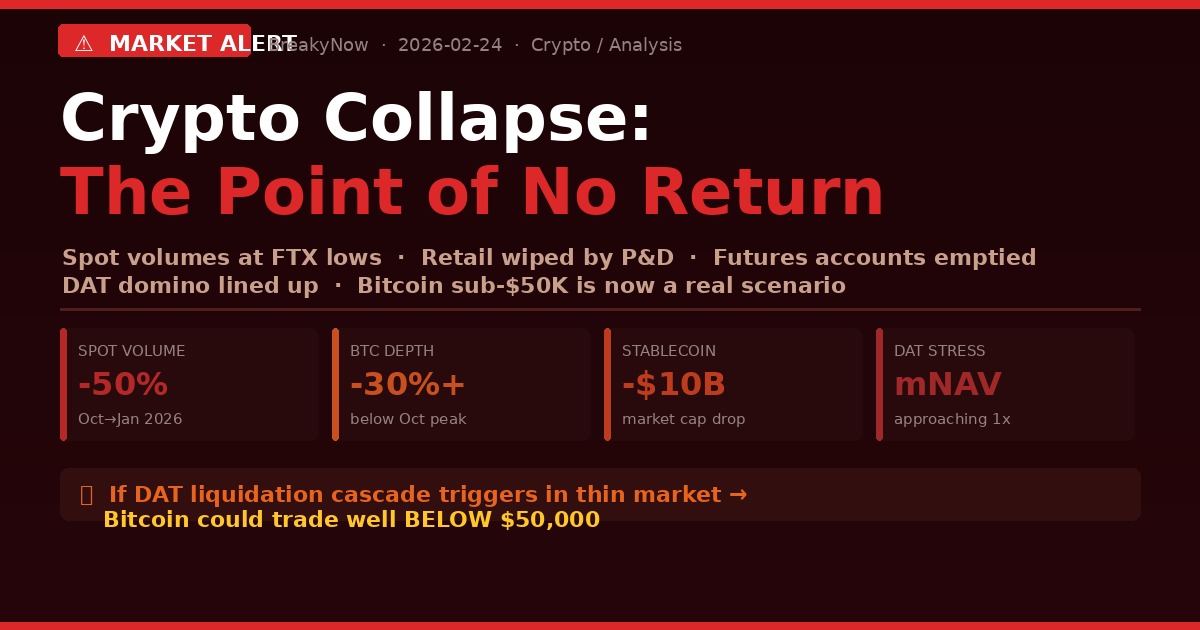
There is a particular kind of financial danger that announces itself not with a bang, but with a silence. Trading floors go quiet. Order books thin out. Volume charts flatten into a flatline. That is exactly what is happening to the cryptocurrency market right now — and the silence is deafening for anyone paying attention to the right data. The warning signs are no longer speculative. They are measurable, documented, and converging toward a single outcome that seasoned market analysts are increasingly willing to name openly: a structural collapse that could be worse than FTX, more prolonged than the 2022 crypto winter, and capable of driving Bitcoin to levels most retail investors refuse to imagine.
⚠️ Signal #1 — Spot Volume Has Collapsed to FTX-Era Lows
The single most important metric for determining the real health of any market is not price — it is volume. Price can be moved by a handful of large actors with thin order books. Volume cannot be faked at scale. And right now, cryptocurrency spot trading volume is telling a story that the headline price numbers are actively concealing.
According to on-chain analytics firm Glassnode and exchange data compiled by Kaiko, aggregate spot trading volumes across major cryptocurrency exchanges collapsed from roughly $2 trillion in October 2025 to approximately $1 trillion by late January 2026 — a 50% collapse in participation in just three months. On Binance alone, Bitcoin spot trading volume dropped from $200 billion per month to $104 billion. The last time market depth — the capital available to absorb large trades without meaningful price impact — fell this far was after the collapse of FTX in November 2022. Kaiko analyst Laurens Fraussen put it plainly: the current volume contraction resembles the 2017-to-2018 bear market, which saw a 60–70% decline in spot exchange volumes over the following 18 months — and by his estimate, the current cycle is only about 25% of the way through that drawdown. The silence is not the calm before recovery. It is the early innings of something much worse.
CryptoQuant analyst Darkfost described the situation without ambiguity: "Spot demand is drying up." Bitcoin's market depth remains more than 30% below its October 2025 peak. Stablecoin outflows from exchanges have exceeded $4 billion, with total stablecoin market capitalization declining by approximately $10 billion — a critical signal, because stablecoin presence on exchanges is the fuel tank of crypto trading. When stablecoins leave, buying capacity leaves with them.
🏦 Signal #2 — Capital Is Fleeing to Stocks and Real Estate
The question worth asking is not just where the money went — but why it left crypto and where it is going instead. The answer points directly to a structural shift in investor psychology that may prove more durable than any previous crypto downturn. Benjamin Cowen, founder of ITC Crypto, classifies early 2026 as a "late-cycle restrictive digestion" phase, in which real yields in traditional fixed income remain positive (the 10-year real yield hovering near 1.7–1.8%) and monetary policy remains restrictive relative to growth expectations. In plain English: bonds, equities, and real estate all offer meaningful inflation-adjusted returns right now, and crypto offers none of its prior narrative advantages.
Bitcoin has failed to respond to dollar weakness, geopolitical stress, or equity market rallies in recent months — the "digital gold" thesis that attracted institutional allocators through 2024 has quietly been abandoned. Spot Bitcoin ETFs, which drove billions in inflows during the 2024 bull cycle, have now seen months of net outflows totaling billions of dollars. Ray Youssef, CEO of crypto platform NoOnes, summarized the dynamic bluntly: "After widespread losses in 2025 and early 2026, the retail capital base that sustains persistent demand is largely depleted. Without consistent retail inflows, market rallies remain fragile and heavily reliant on short-term positioning." The October 2025 crash — $19 billion in leveraged positions wiped in hours — did more than destroy portfolios. It shattered the narrative. And without the narrative, crypto has no gravity to pull capital back from markets that are actually performing.
🎰 Signal #3 — Pump & Dump Exhaustion Has Destroyed the Retail Base
Every crypto bull market runs on a reliable engine: a new cohort of retail investors, arriving late, buying the top, and providing exit liquidity for earlier participants. The 2020–2021 cycle ran on DeFi summer and NFT mania. The 2024 cycle ran on meme coins, AI tokens, and the ETF approval narrative. In both cases, the pattern was identical: coordinated accumulation by insiders and large wallets, aggressive promotional campaigns on social media, a rapid price surge that attracted retail momentum buyers, and then a swift, devastating distribution phase — what market participants call Pump & Dump — that left the majority of retail entrants deeply underwater.
The difference in 2025–2026 is that this cycle of extraction has now been repeated often enough, across enough projects and token categories, that a critical mass of retail participants have been burned multiple times. The meme coin supercycle of early 2025 wiped out billions in retail capital in weeks. Solana-based token launches, AI agent tokens, and celebrity-endorsed coins followed the same trajectory with ruthless efficiency. The damage is not just financial — it is psychological. The investor who bought SOL memecoins at peak hype, watched a 90% drawdown, and then got liquidated in the October crash on leveraged Bitcoin longs is not coming back to deposit fresh capital. That person is in equities now, or in real estate, or out of markets entirely. The retail engine that every crypto bull cycle depends on has been systematically dismantled by the very extraction mechanisms that made the preceding rally possible.
💣 Signal #4 — Futures Markets Are a Graveyard of Liquidated Accounts
Crypto perpetual futures markets were supposed to provide price discovery and deep speculative liquidity to the broader ecosystem. Instead, they have become one of the primary mechanisms through which retail capital is permanently extracted from the market. The October 2025 liquidation event — $19 billion wiped in hours — was not an anomaly. It was the culmination of a months-long pattern: leveraged long positions built up by retail traders chasing momentum, then demolished in cascade liquidations engineered by hollow order books.
Each liquidation event does two things: it destroys capital, and it destroys confidence. The pool of active futures capital shrinks after every major liquidation wave. Traders who survive reduce their exposure dramatically. Traders who don't survive lose everything and leave. CryptoQuant's on-chain analysis shows a declining buy-volume divergence in Binance futures markets resembling the 2021 cycle structure — price rising on paper while underlying participation consistently deteriorated — a pattern that historically precedes, not follows, a major structural breakdown. The futures markets are no longer a source of new capital. They are a mechanism for recycling the last remaining capital until it is completely gone.
🏚️ Signal #5 — The DAT Domino: When MicroStrategy's Model Breaks
Of all the structural risks accumulating in the current environment, none carries more systemic danger than the Digital Asset Treasury (DAT) sector. Strategy (formerly MicroStrategy) holds over 712,000 BTC — representing more than 3.2% of all Bitcoin in existence — acquired at an average cost basis of approximately $76,000 per coin and funded by more than $8.2 billion in convertible debt and $7.5 billion in preferred stock, generating approximately $779 million in annual interest and dividend obligations. The entire model depends on a single variable: Bitcoin staying above the cost basis while equity markets remain open to new share issuance.
In January 2026, with Bitcoin trading below $76,000, Strategy's position briefly went underwater on its cost basis. CEO Phong Le confirmed publicly that a Bitcoin sale is now formally "in the toolkit" under two conditions: the stock trading below 1x mNAV, and capital markets closing. Both conditions are closer than most believe. The mNAV premium — once a robust 2.66x — has collapsed toward and briefly below 1x. MSTR stock is down more than 60% from its 2025 highs. JPMorgan estimated that MSCI index removal alone could trigger $2.8 to $11.6 billion in forced selling from passive fund outflows.
But the deeper danger is not MicroStrategy in isolation — it is the copycat DAT sector that metastasized around it during the 2024–2025 bull market. Dozens of smaller companies structured themselves around the same flywheel: raise capital by issuing equity, buy Bitcoin, let the mNAV premium expand, issue more equity, repeat. That flywheel only works in one direction. As Bitcoin falls and mNAV premiums compress toward or below 1x, the equity issuance mechanism breaks. Smaller DAT companies — with shallower balance sheets, less liquid debt structures, and no brand recognition to sustain market confidence — are already showing severe stress. A single forced liquidation event from even a mid-tier DAT company could trigger the panic cascade the sector has so far narrowly avoided. The domino that falls first does not need to be the largest one. It just needs to fall at the wrong moment, into a market that is already structurally hollowed out.
The $50,000 Floor — And What Lies Beneath
For most of 2025 and early 2026, the $74,000–$76,000 range functioned as critical support — the approximate average cost basis for Strategy's holdings and the broader cohort of institutional buyers who entered during the ETF-driven rally of 2024. Bitcoin has already tested this level repeatedly. The next meaningful structural support, based on on-chain realized price analysis and historical cycle data, sits in the $40,000–$50,000 range. Below $50,000, Strategy's financial model enters territory where servicing preferred dividends through equity issuance becomes deeply compromised. Below $40,000, a genuine solvency stress scenario begins — not an immediate bankruptcy, but a forced restructuring that would place hundreds of thousands of Bitcoin into a liquidation process unlike anything the market has ever absorbed.
The feedback loop, once triggered, is self-reinforcing. DAT liquidations push Bitcoin lower. Lower prices compress mNAV further. Compressed mNAV destroys the equity issuance mechanism. Destroyed liquidity forces more Bitcoin selling. Forced selling into the thinnest spot order books since the FTX collapse produces price dislocations of extraordinary magnitude. And the thin, liquidated, psychologically exhausted market on the other side of that sell pressure has no remaining capital to provide a bid. This is not a worst-case scenario. It is a scenario that the data, as it exists today in February 2026, describes with uncomfortable clarity.
The cryptocurrency market's next chapter will not be written by another ETF approval, another halving narrative, or another wave of institutional enthusiasm. It will be written by what happens when the last structural support — the belief that DAT companies will never sell — is finally put to the test. That test may already be underway.
This article reflects current market data and analyst commentary as of February 2026 and is intended for informational and analytical purposes only. It does not constitute financial advice. The cryptocurrency market is highly volatile and past patterns do not guarantee future outcomes.