
Tariff Chaos, Round Two: What Actually Happens Next After the SCOTUS Ruling
IEEPA struck down on Friday. 10% global tariff signed Friday night. Raised to 15% Saturday morning. The pattern is clear — and markets need a roadmap.
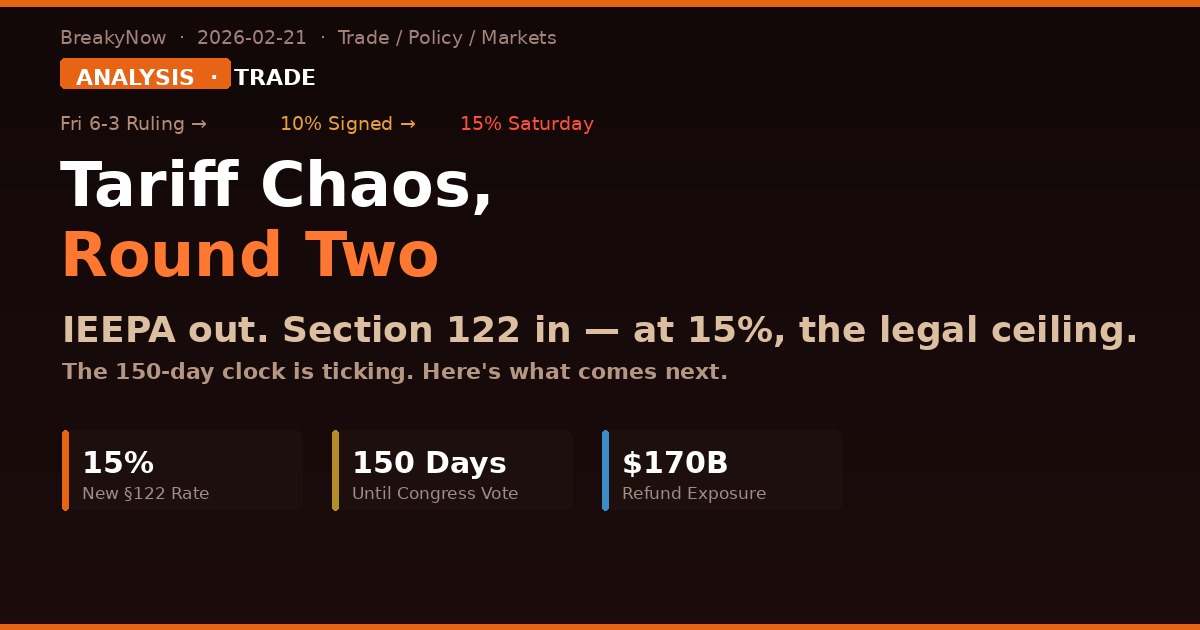
If you were hoping the Supreme Court's 6-3 ruling on February 20 would bring clarity to U.S. trade policy, Saturday's news should have reset those expectations entirely. Less than 18 hours after the court ruled that IEEPA "does not authorize the President to impose tariffs," Trump signed a new 10% global tariff under Section 122 of the Trade Act of 1974. By Saturday morning, he raised it to 15% — the statutory maximum allowed under that law — via Truth Social. Treasury Secretary Scott Bessent's stated goal is explicit: tariff revenue in 2026 should be "virtually unchanged." The legal instrument changed. The policy intent did not. What we are watching now is not the end of the tariff era — it is the beginning of its next, more legally constrained, and arguably more unpredictable phase.
The Legal Chessboard: What Tools Trump Still Has
Understanding what comes next requires mapping the remaining legal architecture. The SCOTUS ruling only invalidated IEEPA-based tariffs — and even that is narrower than the headlines suggest. Section 232 (national security grounds) tariffs remain fully intact: the 25% auto tariff, 50% steel duties, and semiconductor-related levies are all unaffected. Section 301 (unfair trade practices) tariffs — the backbone of the China trade war — also remain in force, covering roughly 36% effective tariff rates on Chinese goods that may now fall to approximately 21% as IEEPA layers are removed. The new Section 122 tariff — now at 15%, the legal ceiling — buys the administration 150 days before congressional approval is required. The administration has also announced it will immediately launch formal Section 232 and Section 301 investigations into additional sectors, a procedural move that typically takes 6–12 months but signals the direction of travel: higher tariffs on semiconductors, pharmaceuticals, shipbuilding, and critical minerals are likely before year-end. The picture that emerges is a tariff regime that is lower than its IEEPA peak for most countries, but structurally permanent for strategic sectors — and with a congressional deadline ticking in the background.
"The Supreme Court did not overrule tariffs. They merely overruled a particular use of IEEPA tariffs." — President Donald Trump, February 20, 2026
The 150-Day Clock: The Most Important Variable in Global Markets
The Section 122 tariff expires in approximately 150 days — around mid-July 2026 — unless Congress acts to extend it. This creates the single most important near-term deadline for global trade and markets. There are three plausible paths from here. First, Congress extends or codifies the tariffs: Republicans have the votes to pass tariff legislation, but the politics are complicated — agricultural states, auto-heavy districts, and retail-dependent constituencies have been hurt. Several Republican senators have already signaled discomfort. A formal congressional tariff bill would likely be narrower, more targeted, and more durable than the executive regime. This is arguably the most market-stabilizing outcome, because it replaces policy uncertainty with legal permanence. Second, the tariff expires without extension: in this scenario, the 15% Section 122 rate falls to zero around mid-July, and the administration must rely solely on Section 232 and 301 tariffs plus any new investigations still underway. This would represent a genuine reduction in the tariff wall for most trading partners — potentially bullish for global equities and emerging markets. Third, Trump escalates via new executive authority: this is the wildcard. The administration has hinted at invoking Section 338 (retaliatory tariffs), the National Security Act, and other rarely-used statutes. Any new legal challenge would likely fast-track back to the Supreme Court, creating another cycle of uncertainty. Markets should assign meaningful probability to all three paths.
Country-by-Country Impact: Winners and Losers in the New Regime
The shift from IEEPA to Section 122 does not affect all countries equally, and this asymmetry matters for global equity positioning. South Korea is a partial winner: chemicals, pharmaceuticals, and semiconductor exporters now face 15% instead of the prior IEEPA rates — a meaningful reduction. But auto exports (over half of Korea's U.S.-bound shipments) still face the 25% Section 232 tariff, and steel remains at 50%. The Korean government is moving cautiously, wary of disrupting its recent shipbuilding deal with the U.S. China sees a modest improvement — overall effective tariff rates potentially declining from roughly 36% to 21% as IEEPA layers are peeled back — but the Section 301 framework targeting Chinese technology, EVs, and industrial goods remains fully intact and is likely to be extended and expanded through new investigations. The EU faces a more straightforward improvement on most goods, with particular relief for auto exporters (Germany, France) who were subject to IEEPA-based reciprocal rates now removed. European markets responded positively on Friday, and the structural trade relationship looks more stable than at any point since Liberation Day in April 2025. India is in an awkward position — its recent bilateral deal with the U.S. was negotiated partly under IEEPA pressure, and its legal validity and terms may need renegotiation now that the underlying statute is invalidated.
The $170 Billion Refund Wildcard — and Why It's Being Underpriced
The most underappreciated risk in the post-SCOTUS environment is the refund question. The Supreme Court deliberately said nothing about whether importers are entitled to recover the estimated $130–175 billion in IEEPA tariffs already collected. Trump has signaled the administration has no intention of proactively issuing refunds: "I guess it has to get litigated for the next two years," he said. More than 1,500 companies have already filed lawsuits in the Court of International Trade. Major corporations including Costco and Toyota have indicated they will pursue refund claims. If courts ultimately rule that refunds are owed — and the legal logic of "tariffs were illegally collected" strongly suggests they should be — the fiscal and market implications are substantial. A $170 billion government payout would be, in effect, a massive corporate earnings windfall concentrated in import-heavy sectors: retail, e-commerce, auto manufacturing, consumer electronics. It would also add meaningfully to the federal deficit at a moment when bond markets are already watching the fiscal trajectory carefully. The 10-year Treasury's jump to 4.09% on Friday is a leading indicator of this concern.
The Bottom Line: Three Things to Watch in the Next 60 Days
For investors and market participants, the tariff story has moved from a single binary risk (SCOTUS rules for or against) to a multi-variable process with several overlapping timelines. The three most important monitors are: first, congressional posture on the Section 122 extension — any signals from Senate Republicans on willingness to legislate tariffs will be the clearest indicator of the medium-term regime; second, new Section 232 and 301 investigation announcements — these are the mechanism by which the administration will try to rebuild permanent tariff authority, and each new investigation targeting a sector (semiconductors, pharma, shipbuilding) is a market-moving event for that industry; third, refund litigation progress at the Court of International Trade — the first major rulings on whether IEEPA tariff refunds are mandatory will create significant balance-sheet implications for retailers and importers. The chaotic 48 hours between Friday's SCOTUS ruling and Saturday's 15% tariff announcement has already established the pattern for what this phase will look like: policy uncertainty as a permanent condition, with the legal constraints tighter than before but the political will to push them fully intact. For global markets, that means positioning for a wider distribution of outcomes — not a return to pre-tariff normalcy.
This article is for informational purposes only and does not constitute financial advice. Always conduct your own due diligence before making any investment decisions.