
2026's Industrial Compounders: ROK, EMR, and PH Are Quietly Building the Factory of the Future
Rockwell Automation, Emerson Electric, and Parker Hannifin — three blue-chip industrials at the intersection of AI, automation, and aerospace that Wall Street is finally taking seriously
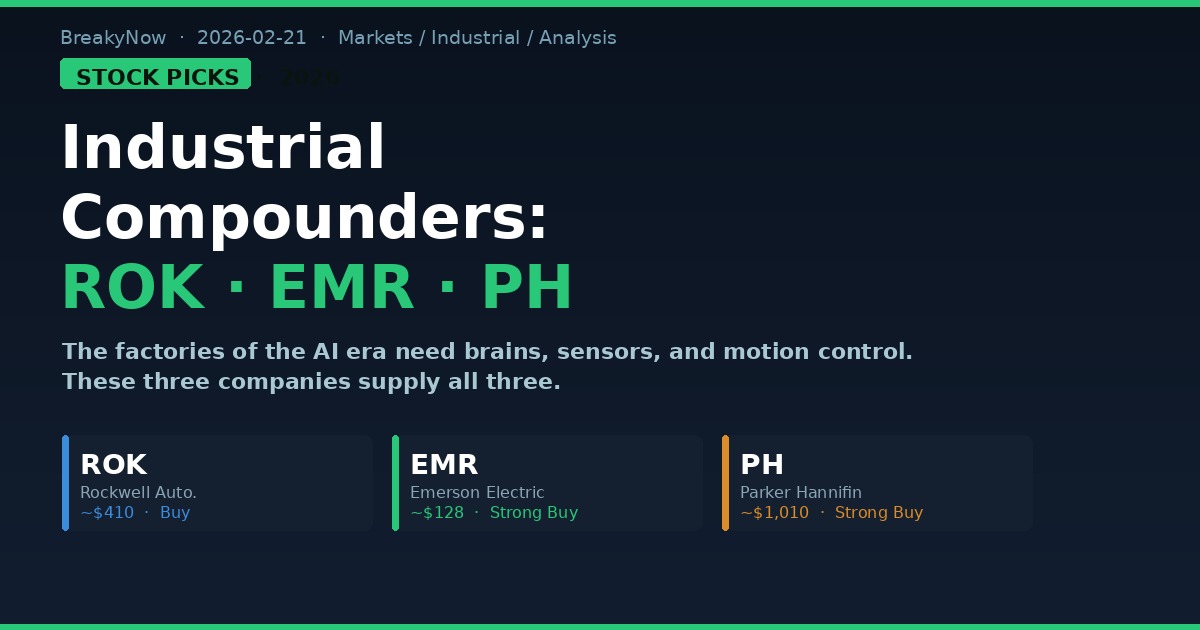
While markets obsess over AI chip designers and cloud hyperscalers, the physical layer of the AI economy — the factories, processing plants, aerospace systems, and motion-control infrastructure that actually make things — is experiencing one of the most compelling capex cycles in decades. Three companies sit at the heart of this shift: Rockwell Automation (ROK), the undisputed leader in industrial software and smart manufacturing; Emerson Electric (EMR), a 135-year-old company reinventing itself as a pure-play automation and process control firm; and Parker Hannifin (PH), the global motion and control giant delivering eleven consecutive quarters of double-digit aerospace segment growth. Together, they offer three distinct risk/reward profiles within the same secular tailwind — and all three are rated Buy or Strong Buy by Wall Street consensus heading into 2026.
🔵 Rockwell Automation (ROK) — The Software Brain of the Smart Factory
Current price: ~$410–432 | Analyst avg. target: $409–416 | Rating: Buy (16 analysts)
Rockwell is the most premium-valued name in this trio — and for good reason. As the dominant provider of industrial automation software, PLCs, and connected factory platforms in North America, Rockwell is effectively the "operating system" for modern discrete manufacturing. Its FY2026 Q1 showed revenue growth of 5.84% — a meaningful recovery from the negative growth rates that plagued the company through the inventory correction cycle of 2023–2024. Operating margins and return on assets are improving in tandem, and free cash flow growth came in at a robust 35%, though analysts note normalization is likely ahead. The current P/E of approximately 47x sits 51% above the 10-year historical average of 31x — a premium that reflects the market's belief that Rockwell has shifted from a cyclical industrial into a recurring-software-revenue industrial, a re-rating that has structural legs as customers embed Rockwell's FactoryTalk platform more deeply into their operations. The key risk is valuation: at these levels, execution must be near-perfect. Any demand softness from automotive or general manufacturing customers — still the core end markets — would compress the multiple quickly. The re-shoring of U.S. manufacturing, accelerated by tariff uncertainty and supply chain restructuring, is a meaningful multi-year tailwind that is only beginning to show up in order books.
Fair Value: $400–$450 | Growth Outlook: ★★★★☆ — Software re-rating story intact; valuation leaves little room for error
🟢 Emerson Electric (EMR) — The Automation Pure-Play That the Market Keeps Underpricing
Current price: ~$128–148 | Analyst median target: $153 | Rating: Strong Buy (8.4/10, 31 analysts)
Emerson is arguably the most compelling valuation story of the three. The company has spent the last three years executing a radical portfolio transformation — divesting non-core businesses (climate technologies, tools and home products) and doubling down on industrial automation software and process control through the integration of AspenTech. The result is a company with a 24.6% operating margin — elite within the industrials sector — and a clear pathway to two-thirds recurring software revenue under its "Project Beyond" initiative. Q1 FY2026 (reported February 3) delivered EPS of $1.46, beating consensus of $1.41, with revenue of $4.35 billion up 4.1% year-over-year. Management raised the bottom of FY2026 EPS guidance to $6.40–$6.55. Trailing 3-month orders grew 9%, backlog expanded 9%, and 12-month orders are up 6% — signals that the demand environment is accelerating rather than plateauing. Evercore ISI raised its target to $185 (Outperform); UBS upgraded to Buy with a $168 target in January; JPMorgan is constructive. The median Wall Street target of $153 implies roughly 19% upside from current levels near $128. TIKR's DCF-based model puts fair value at $179, suggesting the stock remains meaningfully undervalued relative to the cash flow profile.
Fair Value: $153–$179 | Growth Outlook: ★★★★★ — Best risk/reward in the group; software transition creates durable margin expansion
🟠 Parker Hannifin (PH) — The Aerospace Compounder Trading at a Still-Reasonable Premium
Current price: ~$997–$1,012 | Analyst avg. target: $969–$1,025 | Rating: Strong Buy (17 Strong Buy, 1 Moderate Buy, 6 Hold)
Parker Hannifin is one of the great compounders of the industrial sector — a 109-year-old company that has returned more than 44% over the past 52 weeks, versus 11.8% for the S&P 500. The engine of that outperformance is simple: its Aerospace Systems segment has delivered eleven consecutive quarters of double-digit growth, driven by commercial aircraft build rates recovering to post-pandemic highs, strong defense spending globally, and Parker's dominant position supplying hydraulic, pneumatic, and fuel systems to Boeing, Airbus, and Lockheed Martin. Q2 FY2026 (reported January 29) was exceptional — adjusted EPS of $7.65 set a new record, beating the $6.67 consensus estimate by nearly 15%, and record revenue of $5.17 billion grew 9% year-over-year. The company raised FY2026 full-year EPS guidance accordingly. Analysts at Citi raised their target to $1,074; Goldman Sachs moved to $1,032; Baird raised to $1,050. The Street-high of $1,139 from multiple firms implies 13–14% additional upside from current levels. The industrial segment is also recovering — North America industrial operations returned to positive territory — while acquisitions including Curtis Instruments are being integrated ahead of plan. The key watch item is whether commercial aerospace demand can sustain its pace as Boeing works through production ramp challenges.
Fair Value: $1,000–$1,100 | Growth Outlook: ★★★★★ — Aerospace tailwinds plus industrial recovery; genuine compounder with pricing power
The Common Thread: Industrial AI Is Real and It's Spending
What unites ROK, EMR, and PH is exposure to a capital spending cycle that is structural rather than cyclical. The re-shoring of U.S. manufacturing — accelerated by tariff volatility, geopolitical fragmentation, and the CHIPS Act — is creating a wave of greenfield factory construction that requires exactly what these three companies provide: automation software (Rockwell), process control and measurement systems (Emerson), and motion and fluid control hardware (Parker). Layered on top is the AI-driven push to make existing factories smarter: Emerson's intelligent device and digital twin platforms, Rockwell's cloud-connected FactoryTalk suite, and Parker's precision motion systems are all being embedded into AI-enabled manufacturing environments at an accelerating pace. None of this is speculative — it is showing up in order books, backlog data, and margin expansion across all three companies.
Side-by-Side Comparison
For investors deciding between the three, the differentiation comes down to what you are buying. ROK is the highest-conviction software re-rating play, but commands a premium valuation that demands consistent execution. EMR offers the best combination of upside potential, valuation discount, and structural margin improvement — the clearest buy for investors with a 12–24 month horizon. PH is the most proven compounder of the three, with the strongest recent earnings momentum and the most diversified growth drivers (aerospace + industrial + defense), making it the most defensible choice in a risk-off environment. All three benefit from the same macro tailwind. The question is simply which risk profile fits your portfolio.
This article is for informational purposes only and does not constitute financial advice. Always conduct your own due diligence before making any investment decisions.