
After SCOTUS Strikes Down Trump's Tariffs: What Comes Next for Global Markets
A 6-3 ruling rewrites U.S. trade law — but with a 10% global tariff already signed and $175 billion in refunds hanging in the air, the story is far from over
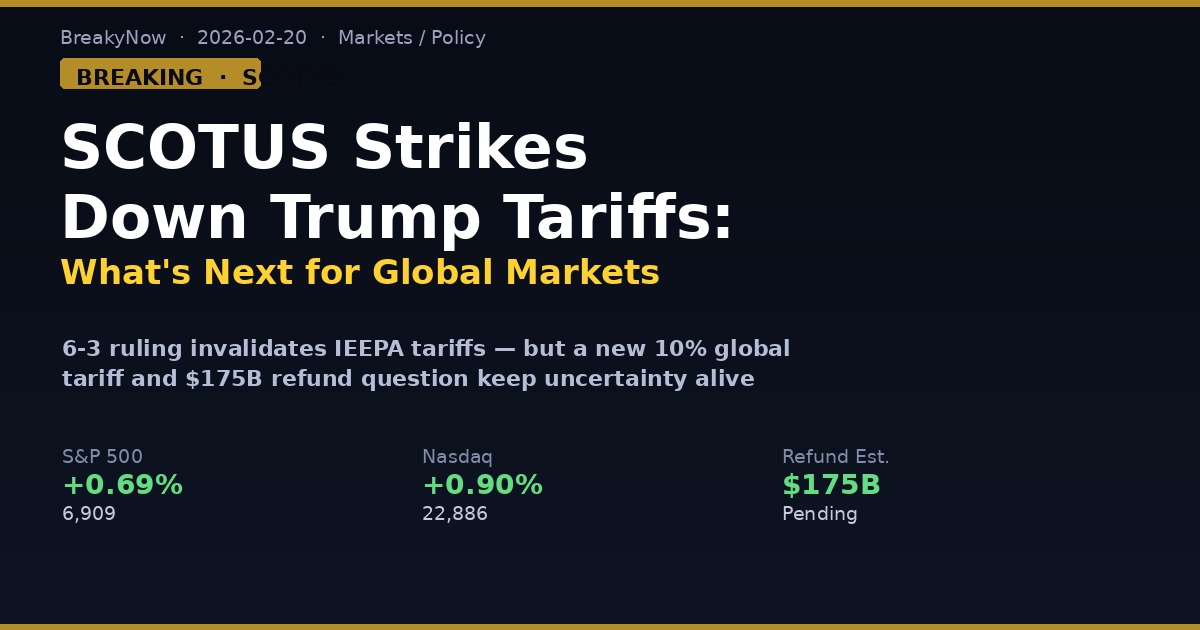
In one of the most consequential economic rulings in decades, the U.S. Supreme Court struck down the majority of President Trump's sweeping tariff regime on February 20, 2026. In a 6-3 decision written by Chief Justice John Roberts, the court held that the International Emergency Economic Powers Act (IEEPA) — the 1977 statute Trump cited to impose tariffs on virtually every U.S. trading partner — "does not authorize the President to impose tariffs." Markets initially surged, then wavered, then closed modestly higher: the S&P 500 gained 0.69% to 6,909.51, the Nasdaq rose 0.90% to 22,886.07, and the Dow added 230 points. The muted reaction belied the magnitude of what just happened — and the complexity of what comes next.
What the Court Actually Ruled — and What It Didn't
The ruling is sweeping but not total. Roberts wrote that the power to impose tariffs requires explicit congressional authorization, and IEEPA — which never uses the word "tariff" — cannot bear the weight of the extraordinary powers Trump claimed. "Until now," Roberts noted, "no President has read IEEPA to confer such power." Crucially, however, the ruling does not address whether importers who already paid IEEPA tariffs are entitled to refunds. That figure is estimated at between $130 billion and $175 billion, depending on the calculation method. Justice Kavanaugh, writing in dissent, warned the refund process "is likely to be a mess." The court also left entirely untouched the tariffs Trump imposed under Section 232 (national security) and Section 301 (unfair trade practices) authorities — both of which remain fully in force. Within hours of the ruling, Trump announced a new 10% global tariff under Section 122 of the Trade Act of 1974 — a statute that limits such tariffs to a maximum of 150 days while trade investigations are completed.
"Just so you understand, we have tariffs, we just have them in a different way." — President Donald Trump, post-ruling press conference, February 20, 2026
The Immediate Market Reaction — Parsing the Signal
Today's trading told a nuanced story. The initial spike on the ruling was sharp but short-lived, and the day's gains were relatively modest given the headline significance. This is consistent with what strategists had expected: markets had already been partially pricing in a ruling against the administration, given months of skeptical signals from the court. The clearest winners were trade-exposed consumer and e-commerce names — Etsy surged 8.39%, eBay gained 3.89%, Amazon rose 2.59%, and Alphabet jumped over 4%. European auto shares and U.S.-listed equities from South Korea and India also rallied on relief that the tariff wall facing their exports had partially fallen. The U.S. dollar index slipped 0.2% to 97.67. Bond yields, interestingly, rose — the 10-year Treasury climbed to 4.09% — suggesting markets are now repricing not just tariff risk but the macro implications: if tariffs partly drove sticky inflation, their removal could change the Fed's calculus. The complication is that Q4 GDP came in at a disappointing 1.4% — far below the 3% consensus — suggesting the tariff drag on growth was real, and its removal may not produce an immediate rebound.
Three Scenarios for Global Markets Over the Next 90 Days
The path forward is genuinely uncertain, and the range of plausible outcomes is wide. In the most optimistic scenario, the Trump administration uses the 150-day Section 122 window primarily as a negotiating tool, tariff rates fall materially from their IEEPA peaks, and global trade volumes begin recovering. In this case, emerging markets — particularly South Korea, Taiwan, and India, which bore disproportionate tariff burdens — could see a sustained re-rating rally. The KOSPI and KOSDAQ, already on a strong uptrend, would have additional fuel. European exporters, especially in autos and industrial machinery, would benefit materially. Global equities in this scenario could see a 5–10% broad rally over the next two quarters. In the base case, Trump aggressively pursues Section 232 and Section 301 tariffs to replace the invalidated IEEPA duties, and Treasury Secretary Bessent's prediction of "virtually unchanged tariff revenue" proves broadly accurate. Markets consolidate near current levels, and the primary variable shifts to the refund litigation and congressional dynamics. The most bearish scenario involves Trump escalating via executive action, testing the limits of remaining tariff authorities in ways that re-trigger uncertainty — potentially while the refund question plays out in courts for years. The political signals are already concerning: Trump called the ruling a "disgrace" and attacked his own nominees by name.
What to Watch: The Refund Wildcard and the Congressional Dimension
The refund question is the most underappreciated risk in the near term. If courts ultimately require the government to refund $130–175 billion to importers, the downstream effects on federal finances, the dollar, and corporate earnings would be significant. Major importers including Costco and Toyota have already signaled intent to pursue refunds. Today's ruling also structurally shifts the balance of trade power back toward Congress. Treasury Secretary Bessent confirmed the administration will rely on Section 232 and 301 authorities going forward, but those statutes require formal investigations — a process that takes months and cannot be reversed by a single executive signature. For global markets, the key metrics to watch are: the USD/KRW and USD/CNY exchange rates as proxies for emerging-market tariff relief sentiment; European auto sector equities (BMW, Mercedes, Volkswagen) as the most tariff-sensitive large-cap cohort; U.S. 10-year Treasury yields for signals on the inflation-growth recalibration; and any congressional action to either formally authorize or constrain the administration's remaining tariff tools. The SCOTUS ruling removes one large uncertainty — but it simultaneously opens several new ones. For global equity markets, that makes this a moment to be selective rather than reflexively bullish.
This article is for informational purposes only and does not constitute financial advice. Always conduct your own due diligence before making any investment decisions.