
The Seoul Effect: How Korean Retail Investors Are Amplifying Volatility in U.S. Nasdaq Stocks
From IonQ to Beyond Meat — when $170 billion in Korean capital chases meme stocks and leveraged ETFs, U.S. markets feel it
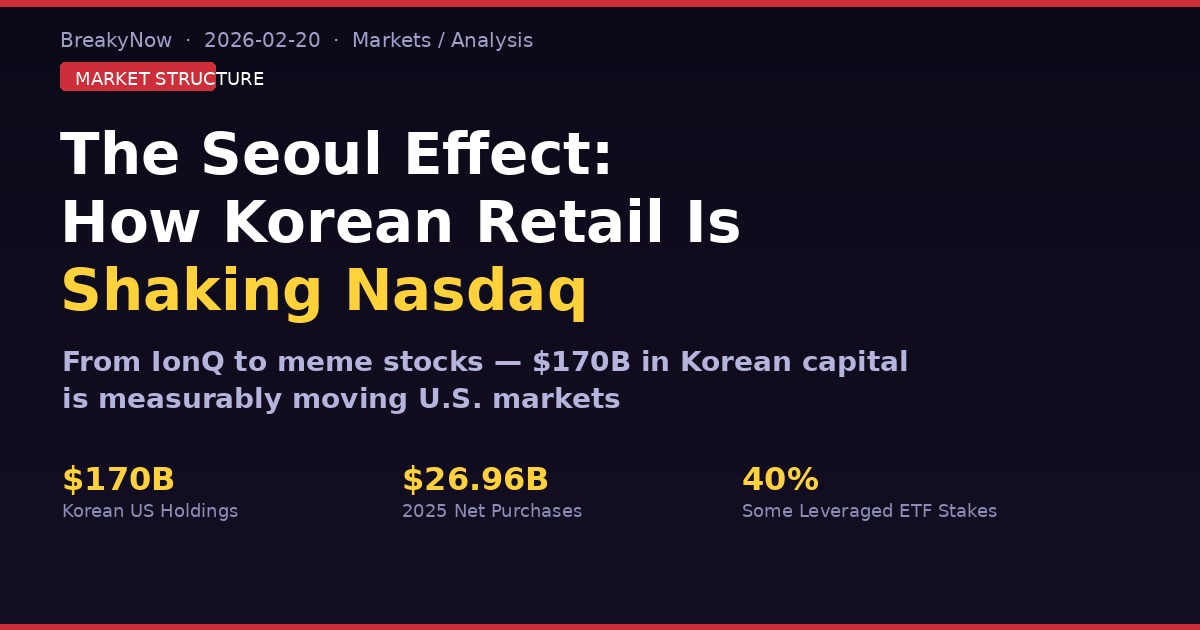
Something structurally unusual is happening in U.S. equity markets, and it has its origin in Seoul apartment blocks, KakaoTalk group chats, and a generation of young Koreans locked out of their own housing market. South Korean retail investors have become a force large enough to measurably move individual U.S. stocks — particularly high-volatility Nasdaq tech names and meme stocks — and Wall Street analysts are only beginning to fully reckon with the implications. Korean overseas equity holdings surged from roughly $85 billion at the start of 2025 to over $170 billion by October, with cumulative net purchases reaching $26.96 billion year-to-date by November. In October 2025 alone, Korean retail investors made net purchases of $6.85 billion in U.S. stocks — exceeding South Korea's entire trade surplus for that same month.
Why Korean Retail Money Is Flooding Into U.S. Markets
The macro backdrop matters here. Domestic Korean housing prices have long been out of reach for younger generations, youth unemployment sits around 7%, and the KOSPI — despite a strong 2025 — has historically been plagued by what markets call the "Korea discount": chronic undervaluation driven by governance concerns, chaebol concentration, and geopolitical risk. Meanwhile, the Korean won depreciated nearly 5% in three months through late 2025, making dollar-denominated U.S. assets both a speculation vehicle and a currency hedge in one. Mobile trading apps have eliminated friction entirely: platforms like Webull-Meritz now allow Korean traders to buy Nasdaq stocks at midnight local time, with seamless foreign exchange conversion. A 2025 survey by Chosun found that 68% of Korean traders under 40 cited "quick riches" as their primary motive for investing in U.S. stocks — a candor that says more about structural domestic despair than irrational exuberance.
"They're not like other global investors — too aggressive." — Jungmin Shim, CLSA Strategist
What They're Actually Buying — and Why It's Unusual
The composition of Korean retail U.S. holdings is where the market impact gets interesting. According to data from the Korea Securities Depository, Korean retail investors own 31% of shares outstanding in one prominent quantum computing stock and 17% of another. They hold 19% of an AI-related firm involved in small modular reactors. In leveraged ETFs, they routinely own more than 20% of shares outstanding — and in at least one 2x single-stock leveraged ETF, their ownership exceeds 40%. Approximately 12% of all Korean retail U.S. holdings are in products that are legally prohibited in South Korea itself — including most leveraged single-stock ETFs and certain derivative structures. In effect, the U.S. market is serving as a regulatory pressure valve: the risk appetite that Korean law tries to suppress at home gets exported directly onto Nasdaq. Beyond the leveraged ETF world, the trend extends into pure meme territory. Korean investors net-purchased $239 million of Beyond Meat (BYND) in October 2025 alone — a company with a negative P/E, a five-year stock decline exceeding 99%, and a 57% analyst "Sell" consensus. The buying was entirely sentiment-driven, coordinated via Korean social media and investment communities on Naver and KakaoTalk.
The Volatility Amplification Mechanism
The structural risk this creates is subtle but real. Korean retail traders tend to enter positions during U.S. after-hours and pre-market sessions, when liquidity is thin and order books are shallow. A concentrated surge of buy or sell orders from Seoul during these windows can set a directional tone that carries into the regular session — a phenomenon researchers have started calling the "Seoul effect." When Korean retail flows converge on a single name — as they did with IonQ (quantum computing), Palantir, Tesla 3x leveraged ETFs, and various meme revivals — the result is price action that is increasingly difficult to explain through fundamental valuation models alone. Vanda Research has noted that meme stock revivals, including names like Krispy Kreme and GoPro, now carry measurable trans-Pacific fuel from Korean buying. Analysts at Acadian Asset Management have warned that this force risks "making the U.S. stock market more like the Korean stock market — more volatile and harder to explain in terms of valuation." The concern is not merely theoretical: JPMorgan data shows U.S. retail inflows in 2025 jumped nearly 60% from the prior year, reaching 17% above the previous record set during the 2021 GameStop mania — and Korean flows represent a meaningful and growing share of that surge.
Regulatory Signals and the Risk of a Reversal
South Korean authorities have taken notice. In late 2025, the government unveiled temporary tax incentives designed to redirect Korean retail capital from U.S. stocks back into domestic equities, as part of broader efforts to stabilize the won, which had approached levels last seen during the 2008–2009 financial crisis. The Bank of Korea has also intervened verbally in currency markets, warning of the self-reinforcing dynamic in which Korean retail dollar demand for U.S. stocks puts sustained pressure on USD/KRW, making foreign assets more expensive in won terms — yet paradoxically encouraging more outflows as a hedge. If this policy pressure succeeds and Korean flows reverse, the stocks most exposed — the leveraged ETFs, the meme names, the thinly traded quantum computing plays — would be the first and hardest hit. The concentration risk cuts both ways: what Korean retail built up rapidly, it could unwind just as fast. For U.S. market participants, understanding who is sitting across the order book is no longer optional — and increasingly, the answer includes a trader in Seoul who woke up at 3 AM KST to chase the opening print.
This article is for informational purposes only and does not constitute financial advice. Always conduct your own due diligence before making any investment decisions.